Does the phrase “the seven seas” sound familiar to you?
Early Greeks used the term to encompass the Aegean, Adriatic, Mediterranean, Black, Red, and Caspian Seas (including the Persian Gulf). Centuries later, Medieval European literature considered it to mean the North, Baltic, Mediterranean, Black, Red, and Arabian Seas, as well as the Atlantic Ocean.
In modern times, the seven seas refer to regions of Earth’s five oceans—the Arctic, North Atlantic, South Atlantic, North Pacific, South Pacific, Indian, and Southern Oceans.
Throughout history, these bodies of water were viewed as distinct regions, adapted over time to embrace the expanding edges of explorers' maps and nautical charts.
Today, however, we know that these regions of the watery world are not as segregated as early explorers once thought. Each of these bodies of water, from the frigid reaches of the Southern Ocean around Antarctica to the balmy Caribbean Sea, are connected through a deep-ocean current called the global ocean conveyor belt.
This global circulation pattern helps cycle nutrients and energy across the planet, supporting the world’s food chain and creating a dynamic marine environment. It also influences how the ocean absorbs solar radiation, distributes heat and moisture around the globe, and drives weather systems.
Travel on the Global Ocean Conveyor Belt
This global deep-sea current, also referred to as the Meridional Overturning Circulation (MOC), is powered by changes in ocean chemistry in different parts of the world. Local differences in seawater temperature and levels of salinity give different parcels of water varying densities, causing them to sink or rise in the water column.
Very cold, salty water—found in the Arctic Ocean where the formation of sea ice excludes salt and increases the salinity of the surrounding waters—is quite dense, causing it to sink thousands of meters down to the ocean floor.
Once at the bottom of the water column, this cold, dense water spreads out to make room for incoming water that is continuing to chill and sink from the surface. This sinking motion pulls in more water from the surrounding surface, creating a current. Together, this process is called thermohaline circulation.
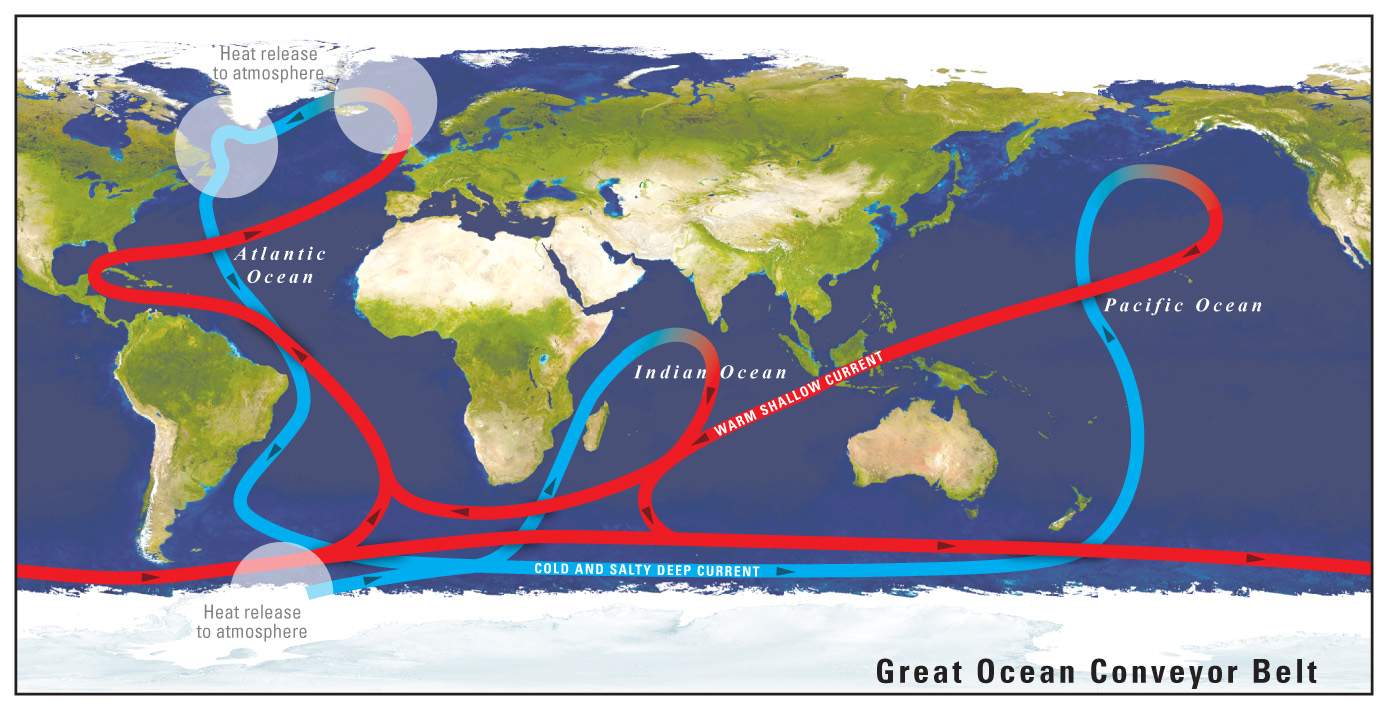
As it spreads, the cold water has nowhere to go but south. It moves across the floor of the Atlantic Ocean, past the equator, and on towards the Antarctic continent, where it is pushed around the southern landmass while being fed more cold, salty water sinking from the surface. From here, the waters split—some is pushed back north towards the Indian subcontinent, and the rest moves towards the North Pacific.
On this journey north, the waters are warmed by the sun, becoming less dense and rising up in the water column as a result of surface winds, equatorial heat influx, and salinity reduction. Once the water reaches its new, higher position in the water column, it once again spreads out to make room for more rising water, creating the second half of the current of the global ocean conveyor belt.
The Atlantic Ocean’s circulation of heat from the equator up to the Arctic is what has traditionally kept weather conditions mild in Europe and the eastern US.
How DOES Climate Change Impact Ocean Currents?
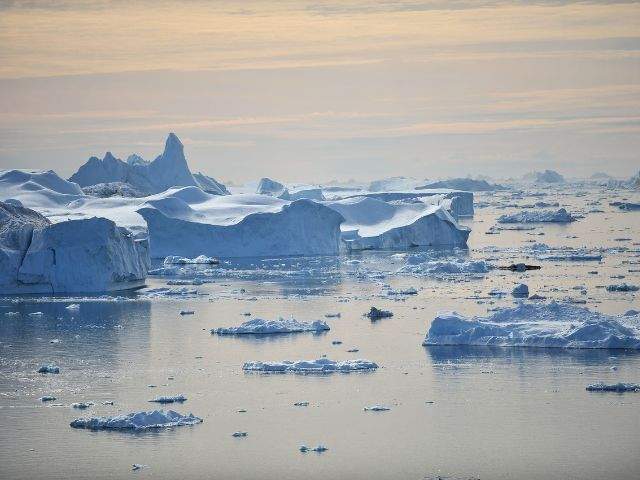
The MOC is vital to the health of the planet’s ecosystems, but it is at risk of being impacted by climate change. While the ocean’s conveyor belt is strong, it is also easily disrupted. An influx of warm freshwater from melting glaciers could disrupt the flow of sinking, colder water, and thereby slow or even stop the current in some regions of the globe.
This is already occurring in places like Greenland, where ice is melting at an accelerated pace. Research published in the journal Nature found that the Atlantic Ocean’s circulation has slowed by about 15 percent since the middle of the last century. Another study warns that the current is in the weakest state experienced in decades, if not centuries.
There are still many unanswered questions about how and why the slowdown is happening. Recent research points to climate change as at least playing a small part. Scientists also believe that the current is still operating in what is historically “normal” behavior and within the bounds of natural variability. However, as the world continues to warm, we could enter uncharted territory.
The Global Current and You
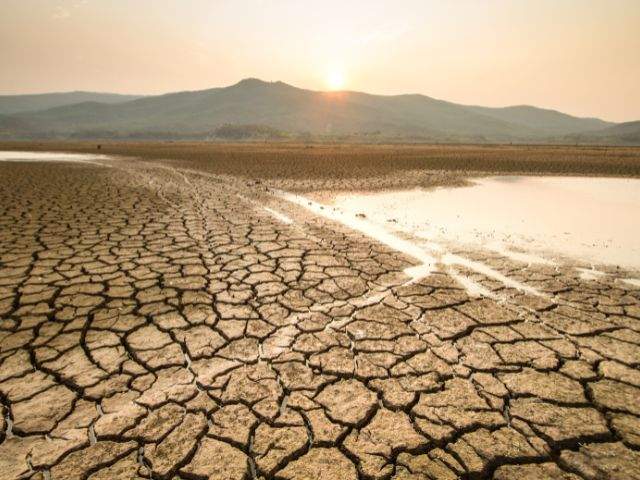
Changes in the global current could lead to major climate shifts. For example, if the MOC in the Atlantic Ocean continues to slow, all countries bordering it will likely experience extreme temperature and weather changes—colder winters across Europe, changing precipitation patterns in places like India and South America, and increased droughts in parts of Africa.
These weather changes could mean shifts in where food is grown and where people are able to live safely. Ocean currents have a big impact on the US economy because they affect things like global shipping, commercial fishing, and recreational boating. Slowing currents could lead to rising sea levels along the eastern seaboard of the US, a disruptive and dangerous phenomenon that some American cities are already preparing for.
Additionally, the ocean plays a vital role in Earth’s carbon cycle. The deep ocean acts as our planet’s largest carbon dioxide reservoir. In fact, the total amount of carbon in the ocean is about 50 times greater than the amount in the atmosphere.
A slower current will decrease the churning of carbon dioxide in the ocean, keeping more of it in surface waters. This increasing acidification is harmful to marine life, as well as the people and communities that depend upon fish and the ocean-based economy.
Learn More About Ocean Currents and Climate Change
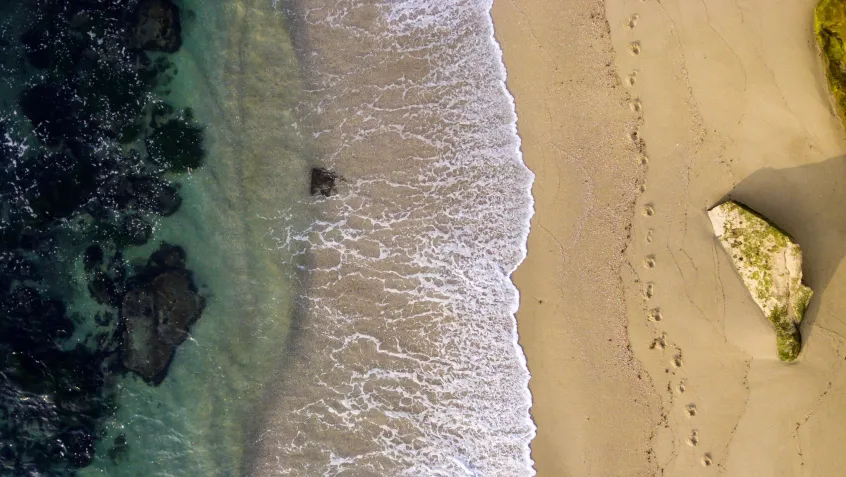
The next time you are at the beach, take a moment to consider how far that water has traveled and reflect on the many ways that the ocean and its currents impact your life. The “seven seas” are actually interconnected and complex ecosystems that support everyone on earth. It’s important to understand what a warming planet could mean for the global ocean conveyor belt and how we can each take action to prevent climate change.
Students and adults alike can use the resources below to learn more about the effect of climate change on the world's oceans and some simple steps we can take in our daily lives to help:
- Climate Kids (NASA): Kids in Grades 4-6 can learn how climate change affects the ocean through games, activities, and information from NASA.
- The Great Ocean Conveyor (Earth Science Week): An interactive activity from the National Oceanic and Atmospheric Administration (NOAA) that helps students in Grades 6-10 understand the movement of the currents.
- The Ocean And Climate (PBS): Grades 9-12 can explore data, maps, and visualizations to better understand the various factors that influence global ocean circulation.
- Extreme Weather 101 (NEEF): Learn the basics about extreme weather and climate change—and how your family can stay prepared—from NEEF’s online course geared toward adults.
- Climate Change At Home (NPS): The National Park Service shares positive actions each of us can take to reduce our greenhouse gas emissions for the benefit of people, parks, and the planet.
Originally published: November 2022 • Updated